A CHALLENGE TO CHASTITY
Correlative Attitudes in Milton and Valmiki
Prof. S. JAGADEESAN
Dr. M. S. NAGARAJAN
Camus is a masque and The Ramayana an epic, a mahakavya
Each is sui generis: each employs systems of literary conventions appropriate
to its form. This paper attempts a study in comparison of the myth of
temptation as handled by Milton and Valmiki. The term “myth”, as Cassirer uses
it, is a kind of perspective. Any body of knowledge, at the time it is
received, involves a synthesising activity of the mind. Myth is not just
story-telling. It is a mode of understanding the truth of an experience, a way,
of envisaging it.
I
Dr.
Johnson always affords us a convenient point of departure. He attacks Camus on
several counts and concludes, “It is a drama in epic style, inelegantly
splendid, and tediously instructive (Italics rirs).”1 True to
the facts of the case, Johnson read it as a masque and found it wanting in
action, for Milton titled the work, “A Masque presented at the Ludlow Castle,
1634,” and it was very much later in time renamed “Comus”, to suit the needs of
the 18th century stage evidently. Well, as a masque it is evidently
unsatisfactory, being heavily loaded with a pair of weighty debates which are
our main points of reference. The substance of the debate is that moral purity
is always threatened by dangers; but the dangers can be overcome by steadfast
human action helped all the time by the grace of God. This argument of the poem
is quite in consonance with the system of the history of religious ideas
prevalent in the 17th century
Camus
opens with the arrival of the attendant spirit promising aid to those
mortals who, despite being confined in this earth, “by due steps aspire/Today
their just hands on that golden key/That opes the palace of eternity”. 2
True knowledge lies in virtue and can be had only from it. Succumbing to
temptation destroys the will and leads to fall from grace. This is
Baited with reasons not unplausible
Wind me into the easy-hearted man,
And hug him into snares. (161-4)
The Lady understands her situation and openly declares in strong theological terms that Conscience, Faith, Hope, Chastity are her guardsmen and that her life and honour would be kept unassailed. Evil’s testimony to beauty is seen in Comus’s reaction to the Lady’s song
But such a sacred and home-felt delight,
Such sober certainty of waking bliss
I never heard till now. (262-5)
The Lady deceived by Comus’s courtesy and its vibrant manifestations, pins her faith to providence. Thematic variations of the basic debate continue during the reflections of the two brothers about the nature of the plight of their sister. The elder brother speaks about the strength of virtue and purity insisting that danger lies within oneself and, docs not come from without.
He that hides a dark soul, and foul thoughts,
Himself is his own dungeon (383-5)
Heaven and Hell are states of mind and they are essentially within us. The elder brother’s speech aptly portrays the two realms of being – Comus’s and the Lady’s. The former is linked by “carnal sensualily to a degenerate state” while the latter is clad in chastity.
So dear to Heaven is saintly chastity,
That when a soul is found sincerely so,
A thousand liveried angels lackey her. (453-6)
As
Virtue may be assailed, but never hurt,
Surprised by unjust force, but not enthralled.
But evil on itself shall back recoil. (586-93)
The major premises of Comus’s specious argument, set in persuasive oratory, are (i) appeal to the sensual appetites, (ii) a pretended concern for the Lady’s welfare, (iii) charging her with acting against Nature’s design, and (iv) seeking public sanction for his way, as it is everybody’s way.
Refreshment after toil, ease after pain,
That have been tired all day without repast,
And timely rest have wanted.. . (686-9)
The Lady’s mind is free though her body is cast under spell and she charges Comus with betraying her credulous innocence. She declares unequivocally:
I would not taste thy treasonous offer
And that which is not good is not delicious
To a well-governed and wise appetite. (702-5)
The heart and core of Camus’s temptation is when he offers a deliberate misinterpretation of Nature’s bounty to man. He subverts the whole edifice of the virtues of abstinence. The riches of the world are created for the benefit of man: they are to be enjoyed and not wasted away unused, for then “the All-giver would be unthanked, would be unpraised.”
Beauty is Nature’s coin, must not be hoarded,
But must be current (739-40)
The, Lady’s answer settles the issue once and for all. She answers Comus not because his seductive offer needs a reply but virtue must check the pride of vice. “Lewdly-pampered Luxury” must not go unchecked. Nature
Means her provision only to the good,
That live according to her sober law,
And holy dictates of spare Temperance, (765-7)
Comus cannot understand the “high-mystery” and “serious doctrine of virginity.” The Lady brings to a grinding halt the debate between the two mutually exclusive orders of existence. There can be no common ground, no meeting point between the two. The argument is clinched in favour of the Lady and so the poem celebrates the triumphal dance of virtue over folly and intemperance. The epilogue rounds off the victorious debate reinforcing the strength of virtue.
Mortals, that would follow me,
Love Virtue: she alone is free;
She can teach ye how to climb
Higher than the sphery chime;
Or if Virtue feeble were.
Heaven itself would stoop to her. (1018-23)
Chastity for which the Lady stands is the virtue. It always goes along with ‘right’ reason and understanding. It encloses restraint, temperance, continence; it is a way of living in the world and loving it too. During the course of the Lady’s harangue against Camus, one cannot fail noticing the transformation in the Lady herself She condescends to him towards the close, her voice is “a flame of sacred vehemence.” While recognising who Comus is, she recognises her true self. Having discovered herself rather than be seduced by him, it is she who seduces him to lead a life governed by virtuous temperance. And Comus amply illustrates, by the convincing victory of the Lady over Comus, the doctrine of Christian Liberty. “Know that to be free is the same as to be pious, to be wise, to be temperate and just, to be frugal and abstinent, and lastly, to be magnanimous and brave”. 3
II
In the Sundarakanda of Srimad Valmiki Ramayana, the episode of the Sita-Ravana samvada is treated in Sargas 19, 20 and 21. Sita is languishing’ grief-stricken in Ashokavan from the separation from her husband and Lord, Rama, on the one hand, and the threat of Ravana’s visit on the other. In Comus, just when the lady completes her song addressed to sweet Echo with the line “And give resounding grace to all Heaven’s harmonies,” seeking aid protection in the wilderness in which she is caught, enters Comus.
Sarga 19 shows Ravana’s arrival and the whole Sarga is a poetic rendering of Sita’s plight, preparing us, as it were, for the debate.


This
is the part of the Sanskrit poetic tradition where, Sita in distress, is
described in terms of conventional similes: she is like a banana tree caught in
cyclone  like a ship drowned in the deep sea
  like the felled branches of a tree
spread-eagled on the floor,
like the felled branches of a tree
spread-eagled on the floor, 
 like the lotus rotting in the mire
  –All these striking botanical similes,
reiteratively employed, fix Sits, the lone figure, in the broader context of Ashokavana,
a lush and wild forest. Ashokavana, the forest dedicated to ebullience and
joy beyond measure, as the name implies, is the prison-house for Sitadevi so
immersed in sorrow and grief. She is wholly out of tune with the surroundings.
All the time the sensuousness in his description of Sita is heightened by
Ravana’s fixed gaze
–All these striking botanical similes,
reiteratively employed, fix Sits, the lone figure, in the broader context of Ashokavana,
a lush and wild forest. Ashokavana, the forest dedicated to ebullience and
joy beyond measure, as the name implies, is the prison-house for Sitadevi so
immersed in sorrow and grief. She is wholly out of tune with the surroundings.
All the time the sensuousness in his description of Sita is heightened by
Ravana’s fixed gaze  repeated again and again. Sita is the single
object of attention all through.
repeated again and again. Sita is the single
object of attention all through.

In
the midst of the huge forest, surrounded by Rakshasa women, the only strength
for Sita is  her, Tapas. The term Tapas in Sanskrit means
one’s spiritual strength, inner resources and here it is Sita’s chastity.
her, Tapas. The term Tapas in Sanskrit means
one’s spiritual strength, inner resources and here it is Sita’s chastity.
Ravana’s
long address to Sita in the 20th Sarga has been variously interpreted by
Bashyakars. For some it has a Rahasyarth according to which Sita is Ravana’s  and he worships and offers her Pooja, for
others it is Ravana’s
and he worships and offers her Pooja, for
others it is Ravana’s  We may slur over these commentaries and take
Ravana’s words as they mean literally in the context without recourse to such
readings. The basic promise of Ravana’s philistinism is the subversion of
conventional morality. It is the very negation of Adi Sankara’s philosophy in Bhajagovindam.
Ravana praises Sita’s beauty, extols her to the skies; she is non
pareil.
We may slur over these commentaries and take
Ravana’s words as they mean literally in the context without recourse to such
readings. The basic promise of Ravana’s philistinism is the subversion of
conventional morality. It is the very negation of Adi Sankara’s philosophy in Bhajagovindam.
Ravana praises Sita’s beauty, extols her to the skies; she is non
pareil.


All earthly pleasures and worldly enticements are offered to Sita. Arguments in favour of youth, its short-lived splendour and transitory nature are built one over the other. Youth is likened to the flooded river, the water of which flows never to come back.
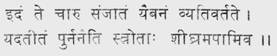
The recurrent term in al1
Ravana’s offer  Ravana advises Sita to cast away all fear,
leave all
Ravana advises Sita to cast away all fear,
leave all  and become his wife:

To force women to lose their chastity, to command them to act in obedience to the wishes, argues Ravana, is his kuladharma and there is no sin in it.

Sita’s fitting reply to Ravana in
33 Slokas is appropriately called, by commentators, Sita’s Gita. In
fact, there is no need for Sita to reply; yet she replies, for silence on her
part might be misconstrued as acceptance of Ravana’s offer. Placing a small
blade of dried grass between her and Ravana, Sita opens her debate which can be
summed up as her advice to Ravana to uphold and pursue the course of
Righteousness, to protect and spread dharma.
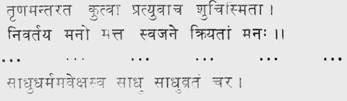
From a position of the meek and lowly, beset by dangers all around, threatened by Ravana’s intentions, one sees Sita transcending these and speaking to Ravana with a high degree of condescension. Ravana was all the time pedestrian, believing that the here and now was the be-all and end-all of human existence. Sita meets every argument of Ravana on individual merits and preaches to him swadharma, opening up to his consciousness a whole world of truth, so far unknown to him or held by him as non-existent.

Sita’s strong faith in virtuous living, her adherence to the moral code is seen in the Sloka where she talks of the impossibility of accepting Ravana.

The
whole domestic image of  using as pillows, seeking support from,
embracing and leaning upon and
using as pillows, seeking support from,
embracing and leaning upon and  the hands, the shoulders, that are meant for
embracing, support and protection with all the associations of mutual
dependence of the husband and wife, the indivisibility of the divine, mutual
contract is organically set in Sita’s rebuttal. The two lines of the Sloka
demonstrate the two mutually exclusive levels of being. The supporting arm of
Rama and the proffered arm of an anamadheya, a stranger. These are two
metaphors for two distinct ways of living. The ordered and organised
value-system where every element is an organic part of the whole is set
against sheer anarchy and disintegration caused by easy acceptance and simple
compromises. A spatial look at Valmiki’s employment of animal imagery in
Sita’s reply – the snake-eagle and the tiger dog combinations, for instance –
reveal the world of bestiality of Ravana. It is this he repudiates firmly.
Sita’s protective armour is her faith in her lord and her chastity. This
chastity does not merely guard her but also Rama. More than anything else, the
first that is in the protective armour is Sita’s chastity.
the hands, the shoulders, that are meant for
embracing, support and protection with all the associations of mutual
dependence of the husband and wife, the indivisibility of the divine, mutual
contract is organically set in Sita’s rebuttal. The two lines of the Sloka
demonstrate the two mutually exclusive levels of being. The supporting arm of
Rama and the proffered arm of an anamadheya, a stranger. These are two
metaphors for two distinct ways of living. The ordered and organised
value-system where every element is an organic part of the whole is set
against sheer anarchy and disintegration caused by easy acceptance and simple
compromises. A spatial look at Valmiki’s employment of animal imagery in
Sita’s reply – the snake-eagle and the tiger dog combinations, for instance –
reveal the world of bestiality of Ravana. It is this he repudiates firmly.
Sita’s protective armour is her faith in her lord and her chastity. This
chastity does not merely guard her but also Rama. More than anything else, the
first that is in the protective armour is Sita’s chastity.
III
To
sum up, in both these works we have chastity under challenge.
Temptation as a rule, involves first a fall from a state of innocence to corruption or loyalty to treachery followed by redemption and grace. In the case of the Lady and Sita, however, it is chastity, the highly developed inner spiritual strength, that not only withstands temptation but overcome it and what more, conquers the tempter.
Notes
1 Samuel Johnson. Life
of
2 John Milton, Camus (Cambridge University Press. 1909). p.7. All subsequent citations are from this text.
3 John Milton, “Second Defence” in Prose Works I, ed. J. A. St. John for Bohn’s ‘Libraries” London. 1843-53. p. 298.
4 Valmiki, Sundarakanda, Stimad Valmiki Ramayanam (Sri Vanivilas Press. Srirangam, 1973) p. 118. All subsequent citations are from this text.